

Refund on Business Closure
Refund on business closure helps eligible businesses review and claim refunds of amounts payable under applicable tax rules when closing operations. My Startup Solution assists with refund eligibility checks, document preparation, tax record review, and filing support to help businesses manage closure-related refund requirements.
Whats Included
- ✓ Business closure refund eligibility assessment.
- ✓ GST and tax payment record review and reconciliation.
- ✓ Refund documentation and application preparation assistance.
- ✓ Filing guidance and follow-up support, as agreed.
Get Free Expert Consultation
Refund on Business Closure
Refund on business closure refers to assistance with identifying, preparing, and submitting eligible refund claims connected with the closure o...
Closing a business involves more than stopping operations. Business owners may need to settle outstanding liabilities, review tax records, cancel registrations, and determine whether any eligible refunds can be claimed. A proper review of financial and tax records can help identify amounts that may be refundable and the steps required to request them.
Refund on business closure refers to assistance with identifying, preparing, and submitting eligible refund claims connected with the closure of a business. Depending on the business structure and the circumstances, this may involve GST refunds, excess tax payments, refundable balances, or other amounts recoverable under applicable laws.
Not every business is automatically entitled to a refund when it closes. Eligibility depends on the type of payment, the relevant tax provisions, supporting records, and applicable deadlines. My Startup Solution helps businesses review their circumstances, organise the necessary documentation, and understand the appropriate refund process.
What Is a Refund on Business Closure?
A refund on business closure is the recovery of an amount that a business is legally entitled to receive after reviewing its accounts and tax position during the closure process.
For example, a business may have made an excess tax payment, accumulated an eligible refundable balance, or paid an amount that can be reclaimed under the applicable rules. However, the closure of a business alone does not create an automatic right to a refund.
The correct process depends on the type of refund involved, the registration held by the business, and the reason for claiming the amount.
Types of Refunds That May Be Relevant
Depending on the facts and applicable laws, businesses may need assistance reviewing:
- GST refunds: Eligible GST refund claims, including qualifying excess payments or other amounts refundable under GST law.
- Excess tax payments: Tax payments made in excess of the amount legally payable, subject to the applicable refund provisions.
- Refundable deposits: Business-related security deposits or other refundable amounts, subject to contractual terms.
- Other eligible recoveries: Amounts recoverable from authorities or other parties where the business has a valid legal or contractual basis.
Each category has different eligibility conditions, documentation requirements, and procedures. The claim must be assessed individually rather than treating all closure-related balances as tax refunds.
Who Needs Business Closure Refund Assistance?
Refund assistance may be useful for businesses that are shutting down, discontinuing commercial activities, or completing the financial settlement process.
This service may be relevant to:
- Proprietorships closing their business operations.
- Partnership firms winding up their activities.
- Limited Liability Partnerships (LLPs) undergoing closure.
- Private limited companies completing a formal closure process.
- Businesses applying for GST registration cancellation.
- Taxpayers who identify excess tax payments or potentially refundable balances.
- Businesses that need to reconcile tax records before completing closure-related compliance.
The procedure for closing a proprietorship is different from the process for striking off a company or winding up an LLP. Therefore, the refund review should consider the legal structure and the status of the relevant registrations.
Our Refund on Business Closure Services
1. Refund Eligibility Assessment
The first step is to identify whether a refund may be available and which legal provisions apply.
The review may consider the reason for closure, the type of payment, the business's tax history, available financial records, and any outstanding liabilities. Where a claim appears possible, the applicable conditions and supporting evidence can be identified before preparing an application.
An eligibility review does not guarantee approval, as the final decision rests with the relevant authority or the party responsible for repayment.
2. GST Refund Review and Assistance
Businesses registered under GST may need to examine their tax position before or during registration cancellation.
Depending on the circumstances, assistance may include:
- Reviewing GST returns and tax payment records.
- Identifying potential excess payments or other eligible refundable amounts.
- Reconciling relevant figures with accounting records.
- Reviewing supporting invoices and other documents.
- Identifying the applicable GST refund procedure.
- Preparing information required for an eligible refund application.
GST refunds are governed by specific provisions and conditions. For example, an electronic credit ledger balance is not automatically refundable merely because a business is closing. Its treatment must be assessed under the applicable GST rules.
3. Tax and Accounting Record Reconciliation
Accurate records are important when determining whether a business has paid more tax than required or has another recoverable balance.
The review may cover:
- Tax payment challans and relevant tax returns.
- Sales and purchase records.
- General ledgers and bank statements.
- GST liability and input tax credit records, where applicable.
- Previously submitted refund applications.
- Outstanding demands or disputed tax amounts.
Reconciliation helps establish the basis of a potential claim and highlights missing information that may need to be addressed before submission.
4. Refund Application Documentation
A refund claim generally requires supporting information appropriate to the type of refund and the applicable procedure.
My Startup Solution can assist with organising relevant documents, preparing claim-related information, checking the consistency of financial records, and identifying additional evidence that may be required.
The exact documentation depends on the nature of the claim. A GST refund, a request for repayment of an excess tax payment, and a contractual deposit recovery may each require different forms and supporting records.
5. Filing Support and Follow-Up
Where included in the agreed scope, assistance may cover preparing an application, checking relevant details, and guiding the business through the applicable submission process.
After filing, the business may need to monitor the application status, respond to requests for additional information, or provide clarifications. Follow-up support depends on the authority's requirements and the nature of the claim.
Any formal dispute, appeal, or complex legal proceeding may require separate specialist advice.
Documents Required for a Business Closure Refund
The required documents depend on the refund category, business structure, and applicable legal requirements. Commonly requested documents may include:
- PAN and business registration details.
- GST registration certificate and cancellation-related records, where applicable.
- Relevant GST returns and tax payment challans.
- Bank statements and accounting ledgers.
- Invoices, credit notes, and supporting transaction records.
- Refund application details and previous departmental correspondence.
- Bank account information and other prescribed declarations.
- Supporting evidence explaining the reason and amount of the claim.
Additional documents may be required depending on the claim. Businesses should provide accurate information and retain copies of submitted applications and supporting records.
Business Closure and GST Registration Cancellation
GST registration cancellation and refund claims are separate compliance matters. A business may need to cancel its registration when it permanently discontinues operations, subject to the applicable provisions and circumstances.
However, cancellation does not automatically result in a refund. Businesses may also need to file outstanding returns, discharge applicable liabilities, and address the treatment of remaining stock or input tax credit.
Under the CGST Act, Section 29 deals with cancellation of registration, while Section 54 governs refunds under GST law. The relevant provisions and procedures should be checked before deciding how to proceed.
How Does the Refund on Business Closure Process Work?
The process generally follows these steps:
- Initial consultation: Review the business closure details, tax position, and reason for seeking a refund.
- Document collection: Gather relevant registration records, returns, payment details, and financial documents.
- Eligibility verification: Assess whether the amount is refundable under the applicable law or contractual terms.
- Reconciliation and preparation: Verify the claim amount and organise supporting evidence.
- Application submission: Prepare and submit the relevant application through the prescribed channel, where applicable.
- Follow-up: Monitor the application and assist with additional information requests within the agreed scope.
The process and timeline vary depending on the refund type, completeness of records, applicable deadlines, and any queries raised by the authority.
Why Choose My Startup Solution for Business Closure Refunds?
Handling a refund claim while closing a business can involve several connected tasks, from checking financial records to understanding the correct filing procedure.
Professional support can help businesses:
- Identify potentially refundable amounts.
- Understand the applicable eligibility conditions.
- Organise supporting tax and financial documents.
- Review discrepancies before submitting a claim.
- Understand the relationship between refund claims and closure compliance.
- Track follow-up requirements and requests for clarification.
My Startup Solution provides practical assistance based on the business's circumstances and the nature of the refund. The scope of work is determined after reviewing the available records and the applicable requirements.
Important Points to Consider Before Applying
Before submitting a refund claim, businesses should check the applicable limitation period, outstanding tax liabilities, documentation requirements, and the legal basis for recovering the amount.
For GST refunds, Section 54 of the CGST Act generally prescribes a two-year limitation period from the relevant date for specified refund claims, subject to statutory exceptions and the applicable rules. The relevant date and limitation period depend on the category of refund.
Business owners should also distinguish between an amount actually refundable under law and a balance that can only be adjusted or used in another permitted manner. A careful assessment can help prevent incorrect claims and unnecessary delays.
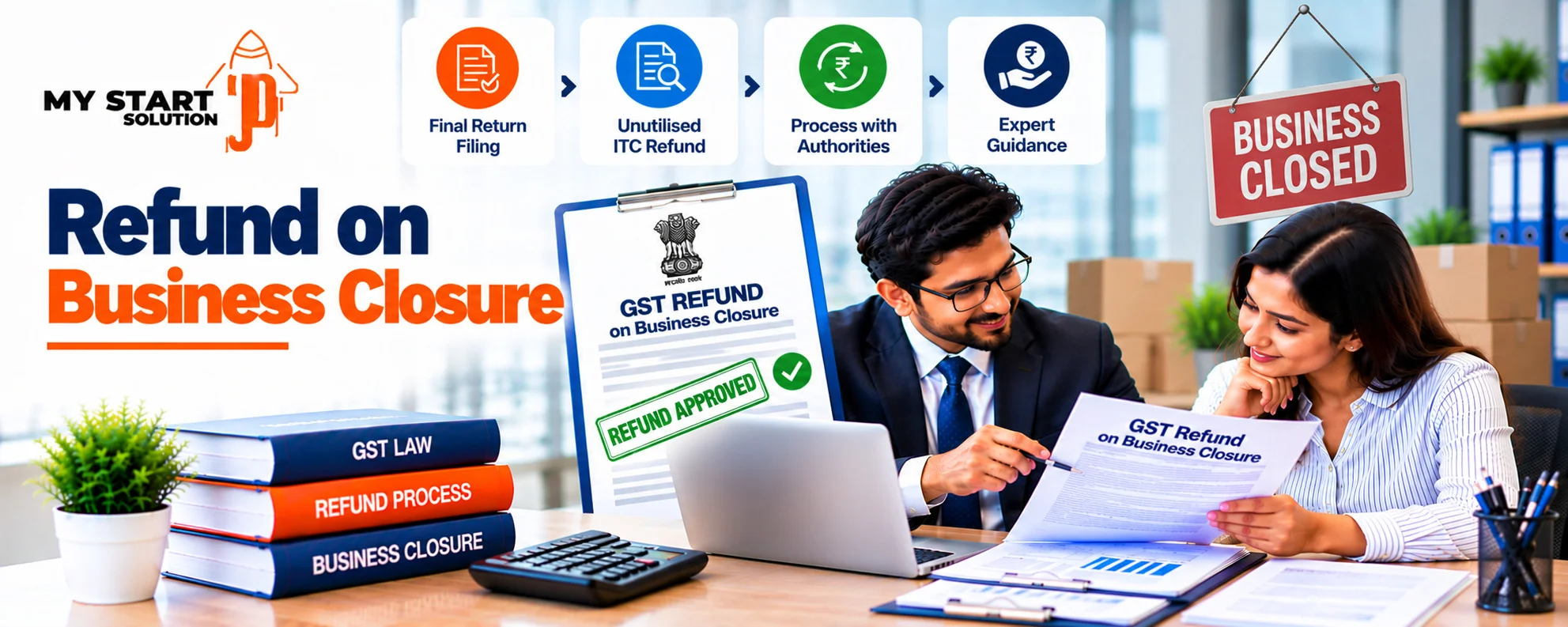
Eligibility Criteria for Refund on Business Closure
- Business Closure Status: Businesses that have discontinued operations or are in the process of closure may be eligible for refunds of excess tax payments, deposits, or other refundable amounts, depending on the applicable rules.
- Outstanding Dues: Pending taxes, penalties, statutory dues, and other liabilities may need to be cleared or adjusted before a refund can be processed.
- Valid Refund Claim: The business must have a valid basis for claiming the refund, such as excess GST payment, an eligible tax credit, or a refundable security deposit.
- Required Compliance: Applicable tax returns, cancellation formalities, and other regulatory requirements should be completed as required for the business type and refund category.
- Supporting Evidence: The applicant should maintain relevant financial records and documents to establish the refund amount and eligibility.
Documents required
Documents Required for a Business Closure Refund
Registration process
A simple four-step process, start to finish.