

Excess Cash Balance Refund
Excess cash balance refund helps GST-registered businesses recover eligible funds remaining in their electronic cash ledger. My Startup Solution assists taxpayers with cash ledger verification, refund eligibility review, application preparation, and supporting documentation to help them follow the applicable GST refund procedure.
Whats Included
- ✓ Electronic cash ledger balance verification and reconciliation.
- ✓ GST refund eligibility assessment and refund amount review.
- ✓ Form GST RFD-01 preparation and supporting document assistance.
- ✓ Refund application status review and assistance with departmental queries.
Get Free Expert Consultation
Excess Cash Balance Refund
An excess cash balance refund allows eligible GST taxpayers to apply for a refund of the amount available in their electronic cash ledger, subject to applicable GST rules and procedures. Instea...
Businesses registered under the Goods and Services Tax (GST) system may sometimes have excess funds available in their electronic cash ledger. This can happen when a taxpayer deposits more money than required to pay GST, makes an advance payment, or has an unused balance after settling tax liabilities.
An excess cash balance refund allows eligible GST taxpayers to apply for a refund of the amount available in their electronic cash ledger, subject to applicable GST rules and procedures. Instead of leaving eligible funds unused in the ledger, businesses can review their balance and determine whether a refund application is appropriate.
My Startup Solution helps businesses review their GST cash ledger, assess refund eligibility, organise supporting documents, and prepare the required application. The service is intended to make the refund process easier to understand and manage.
What Is an Excess Cash Balance Refund Under GST?
An excess cash balance refund refers to a refund claim for eligible amounts remaining in a taxpayer's electronic cash ledger maintained on the GST portal.
The electronic cash ledger records deposits made by a taxpayer for payment of GST liabilities, interest, penalties, fees, and other permitted amounts. If money remains unused after the relevant liabilities have been paid, the taxpayer may be eligible to request a refund under the applicable provisions.
Section 49(6) of the Central Goods and Services Tax (CGST) Act, 2017, provides for the refund of the balance in the electronic cash ledger in accordance with Section 54 and the prescribed rules.
However, an unused cash ledger balance does not automatically mean that a refund will be approved. The taxpayer must satisfy the applicable conditions and follow the prescribed application process.
Who Can Apply for an Excess GST Cash Balance Refund?
GST-registered businesses and other eligible taxpayers may consider applying when funds remain available in their electronic cash ledger and are not required for outstanding liabilities.
This service may be relevant to:
- Businesses that deposited more GST than required.
- Taxpayers who made duplicate or excess cash deposits.
- Companies with unused cash ledger balances after paying their GST liabilities.
- Businesses that deposited funds in anticipation of tax payments that were lower than expected.
- Taxpayers reviewing their GST cash ledger before closing operations or restructuring their business.
- Businesses that want to reconcile their electronic cash ledger and identify potentially refundable amounts.
Eligibility depends on the nature of the balance, the taxpayer's outstanding obligations, and the applicable GST requirements. A review of the ledger and relevant records should be completed before submitting a claim.
Our Excess Cash Balance Refund Services
1. Electronic Cash Ledger Verification
The first step is to review the electronic cash ledger available on the GST portal. This helps establish the amount deposited, the balance remaining, and the relevant payment history.
The review may include:
- Available cash balance under the relevant tax heads.
- Deposit details and challan records.
- Payments made against GST liabilities.
- Differences between ledger entries and internal accounting records.
- Potentially refundable amounts requiring further verification.
This review helps businesses understand their available balance before proceeding with a refund application.
2. Refund Eligibility Assessment
Not every amount shown in a GST account qualifies for the same type of refund. The reason for the excess balance and the relevant legal provisions must be considered.
The eligibility assessment may involve reviewing the taxpayer's registration details, cash ledger entries, outstanding tax liabilities, and supporting records. Where the facts indicate that a refund may be claimed, the appropriate procedure can be identified.
3. Preparation of the GST Refund Application
Eligible taxpayers generally apply for a refund of the electronic cash ledger balance through Form GST RFD-01, as prescribed under the applicable GST refund procedure.
Assistance may include preparing the application details, verifying the refund amount, selecting the appropriate refund category, and checking the information before submission.
The application should accurately reflect the ledger balance and the grounds for claiming the refund. Any supporting documents required for the specific case should also be reviewed.
4. Supporting Document Compilation
Accurate documentation helps support the refund claim and address questions that may arise during processing.
Depending on the case, relevant records may include:
- GST registration details.
- Electronic cash ledger statements.
- GST payment challans and deposit receipts.
- Relevant GST return records.
- Accounting ledger extracts and reconciliation statements.
- Bank account details and other information required by the GST portal.
- Additional documents requested by the jurisdictional GST officer, where applicable.
The final document list depends on the circumstances and the requirements applicable to the refund application.
5. Application Review and Follow-Up
Before filing, the application details should be checked for consistency with the electronic cash ledger and supporting records.
Where included in the agreed scope, assistance may also cover reviewing application status, identifying requests for additional information, and preparing responses to departmental queries.
If the authorities issue a notice, seek clarification, or propose rejection of the claim, the next steps should be assessed in light of the communication and applicable legal provisions.
Documents Required for an Excess Cash Balance Refund
The exact documents depend on the taxpayer's circumstances, but businesses should generally keep the following information ready:
- GSTIN and registration details.
- Electronic cash ledger statement.
- Relevant payment challans and deposit records.
- Details of the refund amount and its basis.
- Relevant accounting records and reconciliation details.
- Bank account information required for the refund process.
- Any additional declarations or documents applicable to the claim.
Keeping the records organised before filing can help reduce avoidable errors and make it easier to respond to further information requests.
Process for Claiming an Excess Cash Balance Refund
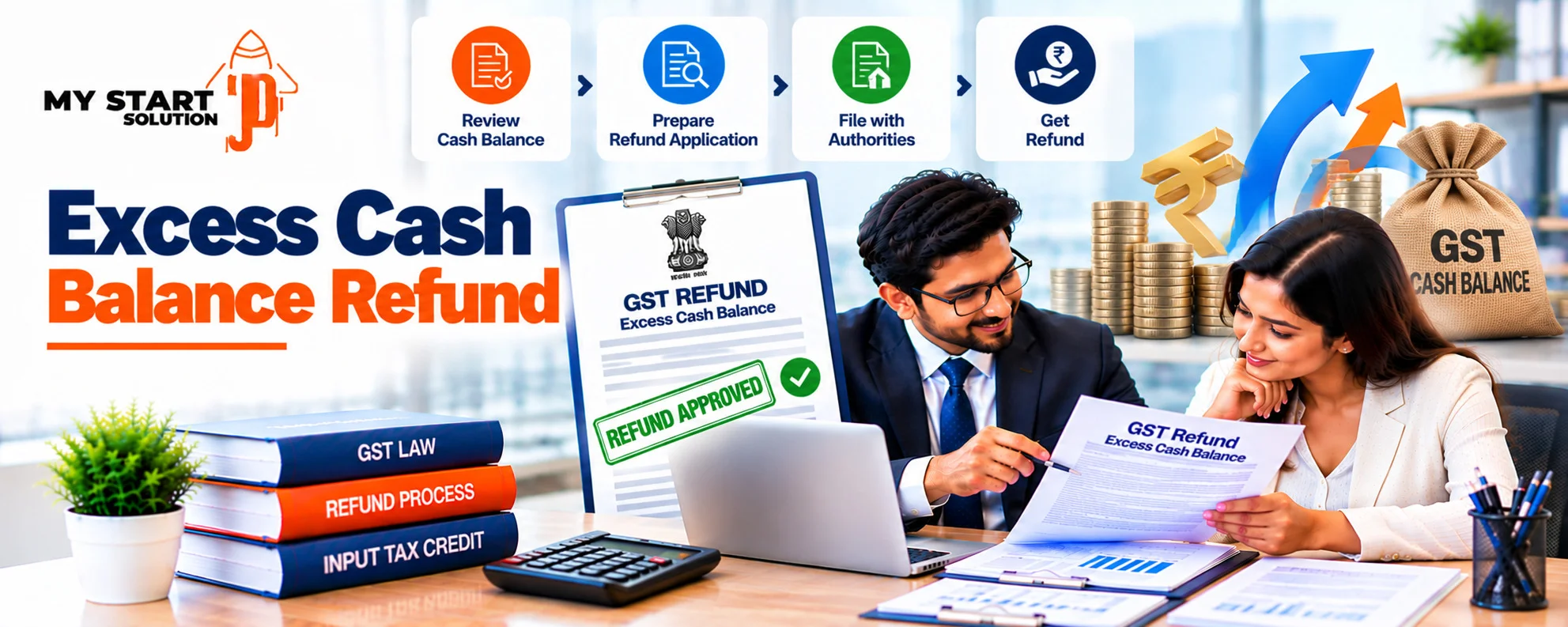
The general process involves the following steps.
Step 1: Review the cash ledger. Check the available balance and identify the amount that may qualify for a refund.
Step 2: Reconcile the records. Compare ledger entries, payment challans, GST liabilities, and accounting records to verify the amount.
Step 3: Assess eligibility. Review the applicable provisions and determine whether the balance can be claimed as a refund.
Step 4: Prepare the application. Complete Form GST RFD-01 with the relevant details and supporting information, as applicable.
Step 5: Submit and monitor. File the application through the prescribed GST portal process and monitor subsequent communications.
Step 6: Respond to queries. If the department requests further information, provide an accurate response within the applicable deadline.
Processing time and the final outcome depend on the applicable rules, the completeness of the application, and any issues raised during verification.
Why Choose My Startup Solution for GST Cash Refund Assistance?
Preparing a GST refund application requires careful checking of the ledger balance, refund category, supporting records, and filing requirements. Errors in the amount claimed or incomplete information may lead to clarification requests or delays.
My Startup Solution provides assistance with:
- Reviewing electronic cash ledger balances.
- Identifying records relevant to the refund claim.
- Checking refund calculations and supporting information.
- Preparing application details and required documentation.
- Understanding follow-up requirements and departmental communications.
The scope of assistance is determined by the taxpayer's records and the nature of the refund claim. Approval remains subject to the applicable GST law and the decision of the competent authority.
Important Points to Check Before Filing
Before applying for an excess GST cash balance refund, taxpayers should:
- Confirm that the balance is available in the electronic cash ledger.
- Verify that the amount claimed is not needed for outstanding liabilities.
- Reconcile the ledger with payment challans and accounting records.
- Select the correct refund category and follow the prescribed procedure.
- Review the application and supporting documents before submission.
- Keep the acknowledgement and subsequent departmental communications for reference.
Reviewing these details can help taxpayers prepare a more accurate application and manage the refund process with greater clarity.
Eligibility Criteria for Excess Cash Balance Refund
- Excess Balance Available: Businesses may apply for an excess cash balance refund when the amount available in the relevant tax or government account exceeds their actual liability or eligible payment requirements.
- Verified Account Details: The applicant must have valid account credentials and the necessary registration details to verify the excess balance and submit the refund request.
- No Outstanding Adjustments: Any pending tax liabilities, dues, or adjustments should be reviewed because they may affect the amount eligible for a refund.
- Supporting Records Available: Applicants should maintain payment receipts, account statements, challans, and other relevant records to establish the excess amount.
- Compliance with Applicable Rules: Refund eligibility depends on the type of account, the reason for the excess balance, and the rules of the relevant department.
- Correct Applicant Information: The refund application should contain accurate business details and bank account information, as required by the applicable refund procedure.
Documents required
Documents Required for Excess Cash Balance Refund
Registration process
A simple four-step process, start to finish.