
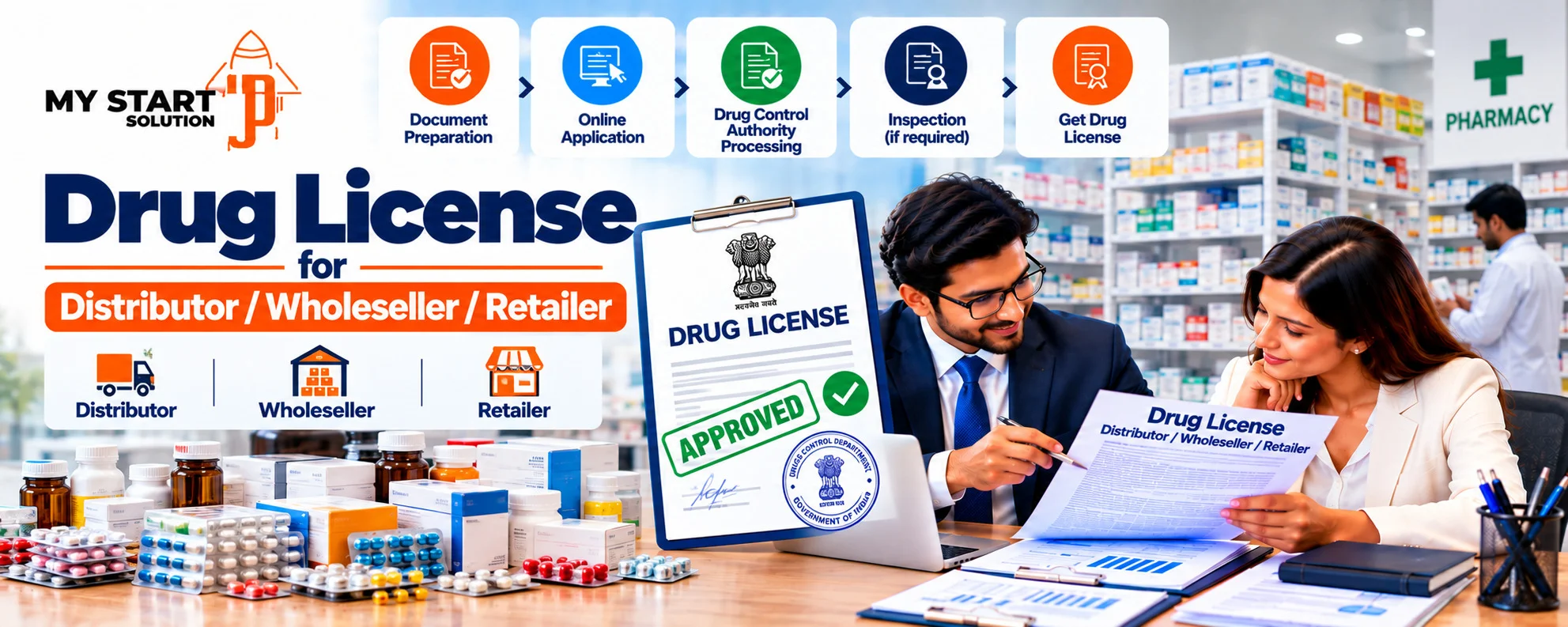
Drug License for Distributor/Wholeseller/Retailer
A drug license is required for eligible businesses involved in the sale, distribution, or wholesale supply of medicines in India. My Startup Solution assists retailers, wholesalers, and distributors with application preparation, document verification, and guidance on applicable licensing requirements to help them establish their pharmaceutical businesses in accordance with relevant regulations.
Whats Included
- ✓ Drug license category assessment for retail, wholesale, or distribution activities.
- ✓ Document checklist and application document verification.
- ✓ Application preparation and submission guidance.
- ✓ Assistance understanding departmental queries and post-license compliance requirements.
Get Free Expert Consultation
Drug License for Distributor/Wholeseller/Retailer
The licensing framework is governed primarily by the Drugs and Cosmetics Act, 1940, and the Drugs Rules, 1945. The applicable license de...
A drug license is an important legal requirement for eligible businesses that sell, stock, distribute, or supply medicines in India. Whether you plan to open a medical store, operate a pharmaceutical wholesale business, or distribute medicines to pharmacies and healthcare establishments, you must identify the appropriate license for your business activities.
The licensing framework is governed primarily by the Drugs and Cosmetics Act, 1940, and the Drugs Rules, 1945. The applicable license depends on the type of medicines handled, the nature of the business, and the relevant regulatory requirements.
My Startup Solution assists applicants with drug license registration, document preparation, application-related guidance, and compliance requirements for eligible retail and wholesale drug businesses.
What Is a Drug License?
A drug license is an authorization issued by the relevant drug licensing authority that permits a business to undertake specified activities involving medicines, subject to the conditions of the license.
It helps regulate the sale, storage, and distribution of medicines and supports compliance with applicable pharmaceutical laws.
A business may need a retail drug license, a wholesale drug license, or another category depending on its proposed activities. Applicants should determine the correct category before submitting an application.
Types of Drug Licenses for Pharmaceutical Businesses
1. Retail Drug License
A retail drug license is generally required for businesses selling medicines directly to consumers, such as medical stores and pharmacies.
Applicants must meet the applicable requirements relating to premises, qualified personnel, documentation, and storage. For relevant allopathic medicines, retail licenses may include Forms 20 and 21, depending on the category of drugs involved.
This license is suitable for eligible businesses planning to operate a retail pharmacy or medical shop.
2. Wholesale Drug License
A wholesale drug license is intended for businesses supplying medicines to eligible dealers, pharmacies, hospitals, and other permitted buyers rather than primarily selling to individual consumers.
Wholesale businesses must satisfy the relevant requirements for premises, competent personnel, records, and handling of medicines. Depending on the drug category, Forms 20B and 21B may apply to wholesale sales of specified allopathic medicines.
3. Drug License for Distributors
Pharmaceutical distributors involved in supplying medicines to retailers, healthcare institutions, or other authorized businesses generally need the appropriate wholesale authorization.
The required license depends on the products being distributed and the proposed activities. Businesses handling special categories of medicines may be subject to additional requirements.
4. Special or Restricted Drug Licenses
Certain medicines are subject to specific licensing conditions. Schedule X drugs, for example, have separate licensing provisions, while restricted licenses may apply to particular permitted activities.
Applicants should not assume that a standard retail or wholesale license covers every medicine category. The applicable forms and conditions must be checked with the relevant licensing authority.
Who Needs a Drug License?
A drug license may be required by businesses engaged in regulated medicine sales or distribution, including:
- Medical stores and retail pharmacies.
- Pharmaceutical wholesalers and stockists.
- Medicine distributors and supply businesses.
- Businesses supplying medicines to eligible healthcare institutions.
- Entrepreneurs planning to establish a pharmaceutical trading business.
- Existing businesses expanding into additional regulated medicine categories.
The exact requirement depends on the business model, the medicines involved, and the relevant state licensing rules.
Documents Required for Drug License Registration
The documents required can vary by state, license category, and business structure. Applicants may commonly need to prepare the following:
- PAN card and identity proof of the proprietor, partners, or directors.
- Proof of the business address and premises ownership or a valid rent agreement.
- Business constitution documents, such as a partnership deed or certificate of incorporation, where applicable.
- Premises layout or site plan, where required.
- Details and qualification documents of the registered pharmacist or other eligible competent person, as applicable.
- Photographs and prescribed application forms.
- Relevant declarations, affidavits, and fee payment records.
- Other documents requested by the state drug licensing authority.
For example, Uttar Pradesh's official licensing guidance lists identity and qualification records, premises documents, business registration papers, and fee-related documents among the requirements for drug sale licensing.
Applicants should obtain a current checklist for their specific license rather than relying on a general list alone.
Eligibility Criteria for a Drug License
Before applying, applicants should check whether their business meets the requirements applicable to the proposed license.
Business Premises
The applicant must have suitable premises that satisfy the applicable requirements for the type of drug business. The authority may require proof of possession, a premises plan, or other supporting records.
Qualified Pharmacist or Competent Person
Retail pharmacies generally need a registered pharmacist to meet the applicable requirements. Wholesale businesses must meet the relevant requirements for a competent person, including prescribed qualifications or experience where applicable.
Suitable Storage Arrangements
The premises must have appropriate storage facilities for the medicines being handled. Certain products may require specific temperature controls or other storage arrangements.
Business Documentation
The applicant should maintain consistent business details across the application, identity documents, premises records, and other supporting paperwork.
Meeting these requirements does not automatically guarantee approval. The licensing authority determines eligibility based on the applicable law and the documents submitted.
Process for Drug License Registration
My Startup Solution provides guidance through the main stages of the application process.
Step 1: Understand the License Category
Identify whether the business requires a retail license, wholesale license, or another category based on its activities and the medicines it intends to handle.
Step 2: Prepare the Required Documents
Collect identity proof, business registration documents, premises details, personnel qualifications, and other records required for the selected license.
Step 3: Complete the Application
Prepare the applicable forms and submit the application through the prescribed state licensing portal or other authorised process. Requirements and application procedures may differ between states.
Step 4: Respond to Verification Requirements
The licensing authority may review the application, inspect the premises, or request additional information. Applicants should respond accurately and within the prescribed time.
Step 5: Receive the Licensing Decision
The authority considers the application and supporting documents before deciding whether to issue the license. Once granted, the business must follow the conditions stated in the license and applicable laws.
Why Choose My Startup Solution for Drug License Assistance?
Applying for a drug license involves more than completing a form. Applicants need to identify the correct license category, prepare the necessary records, and understand the requirements for their premises and personnel.
My Startup Solution assists with:
- Identifying the appropriate license category for the proposed business.
- Preparing and checking the application documents.
- Understanding premises and personnel requirements.
- Providing guidance on application submission and departmental queries.
- Understanding applicable post-approval compliance requirements.
The service is intended to help applicants approach the licensing process in an organised manner. The final requirements and decision remain with the relevant drug licensing authority.
Drug License Renewal and Compliance
After obtaining a drug license, businesses must continue to comply with its conditions and the applicable drug regulations.
Depending on the license and current rules, ongoing responsibilities may include:
- Maintaining purchase and sale records.
- Purchasing medicines from authorised sources.
- Following applicable storage and handling requirements.
- Keeping the license and required records available for inspection.
- Reporting relevant changes to the licensing authority.
- Completing retention, renewal, or other formalities when applicable.
Certain sale licenses may remain valid perpetually subject to prescribed compliance assessments, while other requirements and procedures may differ. Therefore, businesses should verify the current conditions applicable to their specific license rather than assume that every license requires the same renewal process.
Eligibility Criteria for Drug License for Distributor, Wholesaler and Retailer
- Suitable Business Premises: The applicant must have suitable premises for storing and selling medicines. The required area and facilities depend on the type of drug license and applicable drug regulations.
- Qualified and Competent Personnel: Retail drug licenses generally require the supervision of a registered pharmacist. Wholesale drug licenses require qualified personnel who meet the applicable educational and experience criteria.
- Proper Storage Facilities: The premises must have appropriate storage arrangements to maintain medicine quality, including temperature-controlled facilities wherever required.
- Compliance with Drug Regulations: Applicants must meet the applicable requirements of the Drugs and Cosmetics Act, 1940, and Drugs Rules, 1945, including relevant licensing conditions.
- Valid Business Registration: The applicant should have the necessary business details, premises proof, and supporting registrations or documents required by the licensing authority.
- Approval from the Licensing Authority: The applicant must submit the application to the relevant State Drug Control Department and satisfy its requirements before starting regulated drug sales or distribution.
Documents required
Documents Required for a Drug License for Distributor, Wholesaler and Retailer
Registration process
A simple four-step process, start to finish.